


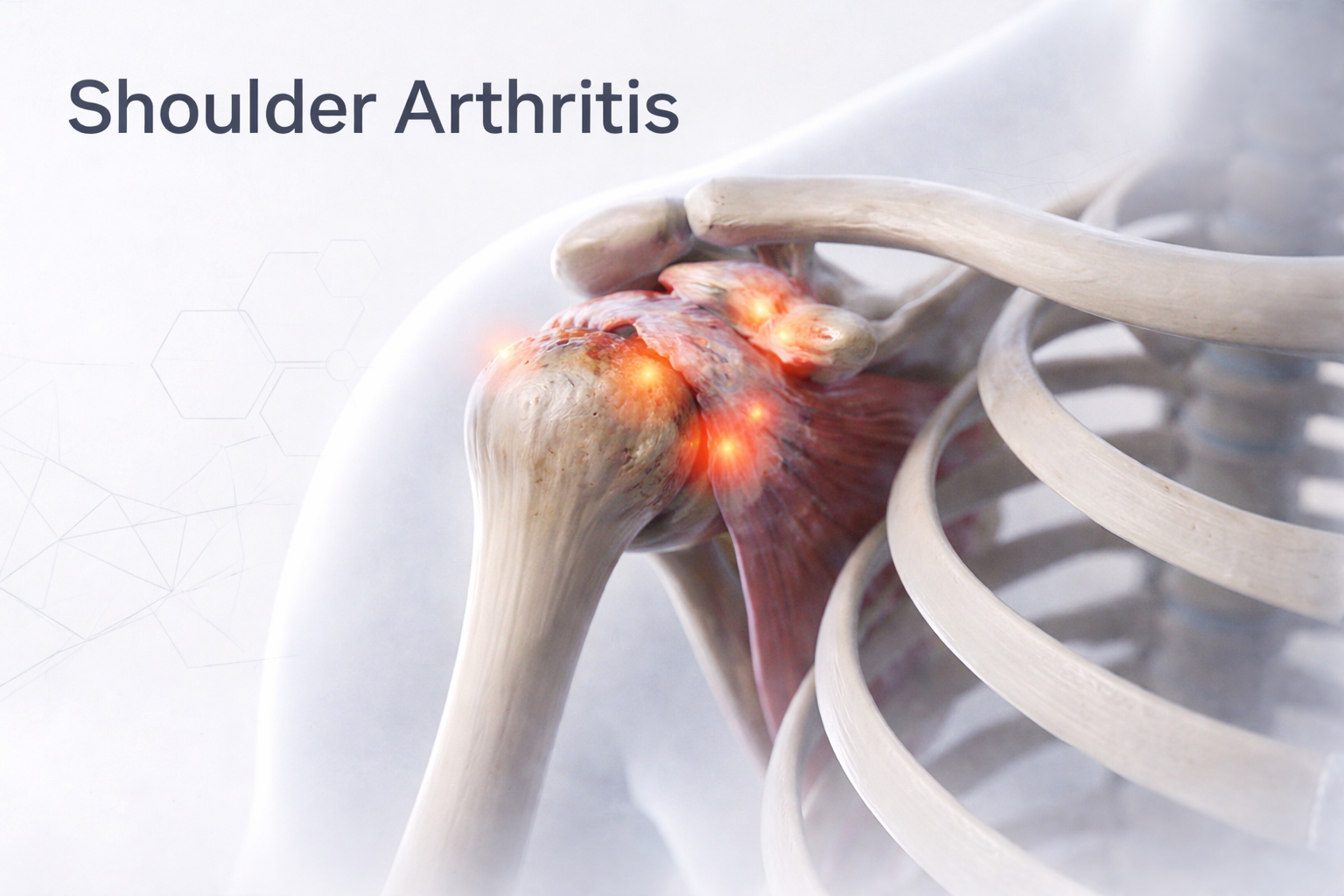
Shoulder Arthritis refers to the wear-and-tear degeneration of the cartilage covering the ball-and-socket joint of the shoulder (the glenohumeral joint).
As cartilage erodes, the bones rub directly against each other, leading to pain, stiffness, grinding, and progressive loss of movement.
Patients often complain of pain even at rest or at night, difficulty lifting the arm, and creaking sounds (“crepitus”) while moving the shoulder.
⚙️ How Does it Develop?
The shoulder is one of the most mobile joints in the body and depends heavily on cartilage and soft-tissue balance for smooth motion.
Over years of use, injury, or inflammation, the joint surfaces deteriorate.
In some, it results from age-related wear, while in others it follows trauma, rotator cuff tears, infection, or autoimmune disease such as rheumatoid arthritis.
🧩 Types of Shoulder Arthritis
- Osteoarthritis (Degenerative Arthritis):
Gradual age-related cartilage wear; most common in middle-aged or elderly patients. - Rheumatoid / Inflammatory Arthritis:
Autoimmune inflammation of the joint lining causing pain and destruction of cartilage and bone. - Post-Traumatic Arthritis:
Develops after fracture, dislocation, or surgery. - Cuff-Tear Arthropathy:
Occurs when long-standing rotator cuff tears allow the humeral head to migrate upward, damaging the joint surface. - Avascular Necrosis (AVN):
Interruption of blood supply to the humeral head leads to collapse and secondary arthritis.
⚠️ Risk Factors
- Age > 50 years
- Previous shoulder injury or dislocation
- Chronic rotator cuff tear
- Rheumatoid or autoimmune disease
- Family history of arthritis
- Smoking, steroid use, or alcohol abuse (linked to AVN)
🔬 Etiology & Pathophysiology
Loss of the smooth cartilage lining the humeral head and glenoid leads to bone-on-bone contact.
The body attempts to repair by forming osteophytes (bone spurs), which further restrict movement.
Synovial inflammation and joint capsule thickening increase stiffness.
Over time, joint space narrows, muscles weaken, and deformity may develop.
🧪 Investigations
- Clinical Examination:
- Painful restriction of both active and passive movement.
- Crepitus felt during rotation.
- Muscle wasting in advanced stages.
- Imaging:
- X-rays: Show joint-space narrowing, bone spurs, sclerosis, and deformity.
- MRI: Useful for assessing rotator cuff integrity and cartilage loss.
- CT Scan (3D): Helpful for surgical planning in arthroplasty cases.
💊 Management
🩹 Non-Surgical Options (Early / Moderate Arthritis)
- Activity Modification: Avoid repetitive overhead work and heavy lifting.
- Medications: Anti-inflammatory drugs and pain relievers.
- Physiotherapy:
- Range-of-motion and rotator-cuff strengthening.
- Posture correction and joint-mobility maintenance.
- Injections:
- PRP, Viscosupplement (Hyaluronic acid), or Corticosteroid injections provide temporary relief and delay progression.
🩺 Surgical Options (Advanced Arthritis)
- Arthroscopic Debridement: Cleaning inflamed tissue and bone spurs for early-stage disease.
- Hemiarthroplasty: Replacement of only the humeral head (for preserved glenoid).
- Total Shoulder Replacement (Anatomic TSA): Replacement of both humeral head and glenoid with prosthetic components — indicated when rotator cuff is intact.
- Reverse Shoulder Arthroplasty (RSA):
For cuff-deficient or arthropathy cases; reverses ball-and-socket orientation to restore deltoid power. - Rehabilitation:
Structured physiotherapy begins immediately post-op; most patients regain functional motion by 3–6 months.
⏳ Sequelae if Left Untreated
- Persistent pain and night discomfort
- Progressive stiffness and deformity
- Loss of strength and ability to perform overhead or daily activities
- Secondary rotator-cuff degeneration
- Irreversible joint damage requiring complex reconstruction later
🌟 Prognosis
Modern arthroscopic and replacement techniques deliver over 90 % success rates with excellent pain relief and restored function.
Patients typically return to pain-free routine and sports-level activity after tailored rehabilitation.
💬 Key Takeaway
“Shoulder arthritis doesn’t just limit motion — it limits lifestyle.
With precise diagnosis and advanced joint-preserving or replacement options, comfort and confidence can be completely restored.”