
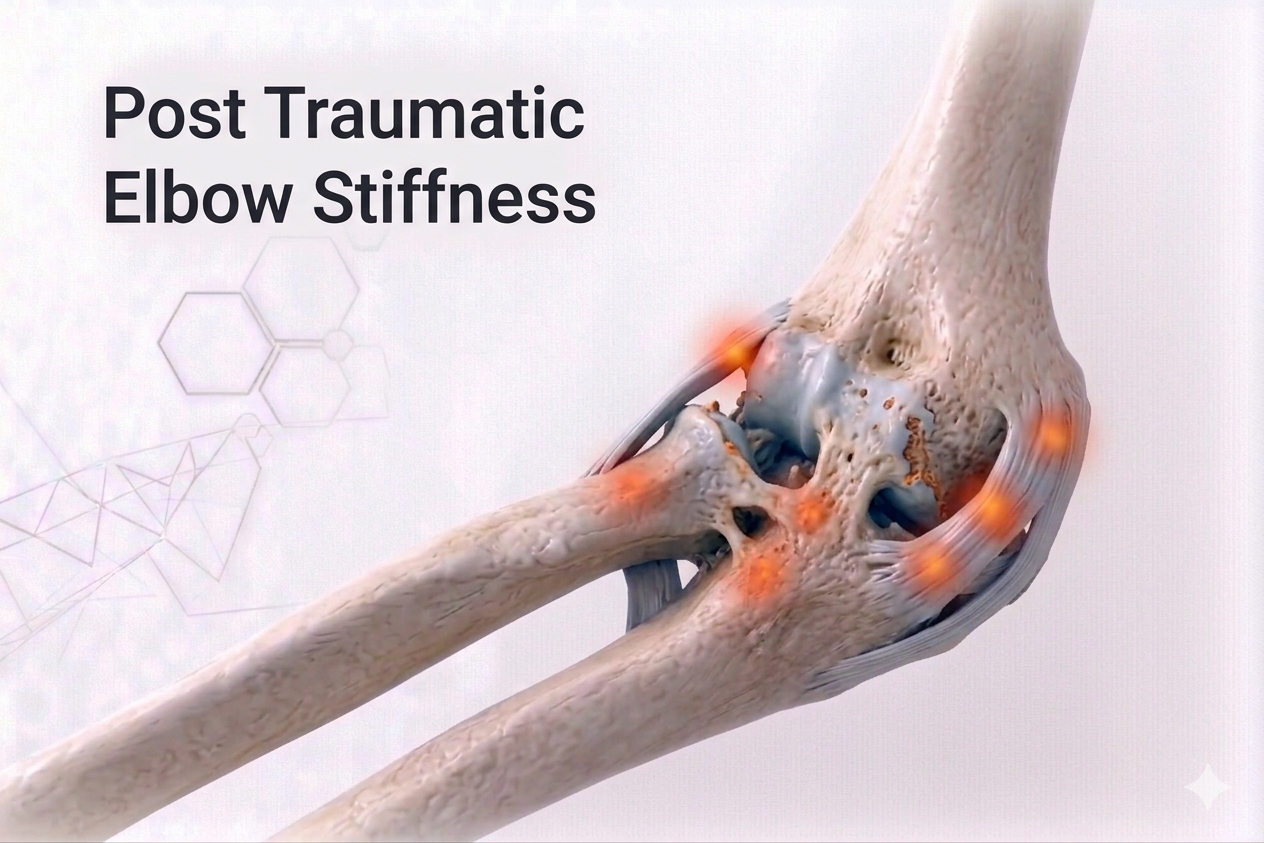
What is Post-Traumatic Elbow Stiffness?
Post-Traumatic Elbow Stiffness refers to restricted range of motion at the elbow joint following an injury, fracture, dislocation, or surgery.The elbow is a hinge joint that depends on precise movement between bone, cartilage, and soft tissues.Even minor injuries can trigger scarring, fibrosis, or bony overgrowth, leading to stiffness and loss of function.
Patients commonly complain of difficulty in bending or straightening the elbow, pain or tightness around the joint, and problems with daily activities like eating, grooming, or wearing clothes.
⚙️ How Does it Develop?
After an elbow injury, the body forms scar tissue as part of the healing process.If the joint is immobilized for too long, or if the injury causes inflammation and bleeding into the joint, these tissues can harden and restrict movement.Additionally, bone fragments or callus formation after a fracture can physically block joint motion — a condition called bony impingement.
Thus, stiffness may be:
• Soft-tissue related (capsular contracture, fibrosis, muscle adhesions)
• Bony related (osteophytes, malunion, heterotopic ossification)
⚠️ Common Causes
• Elbow fractures (radial head, distal humerus, olecranon, coronoid)
• Elbow dislocation (simple or complex)
• Prolonged immobilization post-injury
• Post-surgical fibrosis after internal fixation or ligament repair
• Infection or inflammation within the joint
• Excessive scar formation (genetic or hypertrophic tendency)
🔬 Pathophysiology
The stiff elbow can involve:
• Capsular fibrosis — thickening and contracture of the capsule.
• Muscle and tendon adhesion — especially around triceps and biceps.
• Intra-articular adhesions — between humerus, radius, and ulna surfaces.
• Heterotopic ossification — abnormal bone formation within soft tissues after trauma.These changes restrict both flexion–extension and forearm rotation, resulting in mechanical stiffness.
🧪 Investigations
1. Clinical Examination:
o Reduced active and passive elbow motion.
o Hard (bony) or soft (capsular) end-feel on attempted movement.
o Evaluate pronation–supination and associated nerve function.
1. Imaging:
o X-rays: Show bone union, callus, or bony blocks.
o CT Scan (3D): Essential to identify intra-articular fragments or osteophytes.
o MRI: Assesses soft-tissue scarring and synovial thickening.
💊 Management
🩹 Non-Surgical (Early or Mild Stiffness)
• Early Physiotherapy:
o Gentle, progressive mobilization under supervision.
o Use of dynamic or static splints to gradually stretch the capsule.
• Medications: Anti-inflammatory drugs and muscle relaxants for pain and spasm relief.
• Ultrasound-Guided Injections:
o Hydrodilatation or corticosteroid injections for capsular tightness.
• Heat & Manual Therapy: To improve tissue pliability and reduce contracture.
• Continuous Passive Motion (CPM): Machine-assisted motion post-injury to prevent stiffness.
🩺 Surgical (For Moderate to Severe Stiffness)
• Arthroscopic / Open Arthrolysis:
o Minimally invasive keyhole surgery to remove fibrous bands, loose bodies, and bony blocks.
o Restores smooth movement by releasing the capsule and removing mechanical obstruction.
• Excision of Heterotopic Bone:
o Performed after ossification matures (~6 months).
• Hardware Removal (if impinging):
o Plates or screws causing stiffness are removed.
• Rehabilitation:
o Immediate physiotherapy post-surgery is crucial.
o Early motion under pain control to prevent recurrence.
o Strengthening phase begins by 4–6 weeks.
⏳ Sequelae if Left Untreated
• Persistent restriction of motion
• Loss of functional independence
• Secondary pain in shoulder and wrist due to compensatory overuse
• Joint degeneration or post-traumatic arthritis
• Psychological distress due to long-term disability
🌟 Prognosis
With early physiotherapy and timely surgical intervention, 80–90% of patients regain functional range of motion.Modern arthroscopic release allows precise correction with minimal soft-tissue trauma and faster recovery.Consistency in rehabilitation is the key to maintaining the achieved motion.
💬 Key Takeaway
“After an elbow injury, stiffness is not just a limitation — it’s a race against time.Early mobilization and timely treatment make the difference between a restricted elbow and a fully functional arm.”

Demo@gmail.com

+91 9979076644 / +91 9372952726