



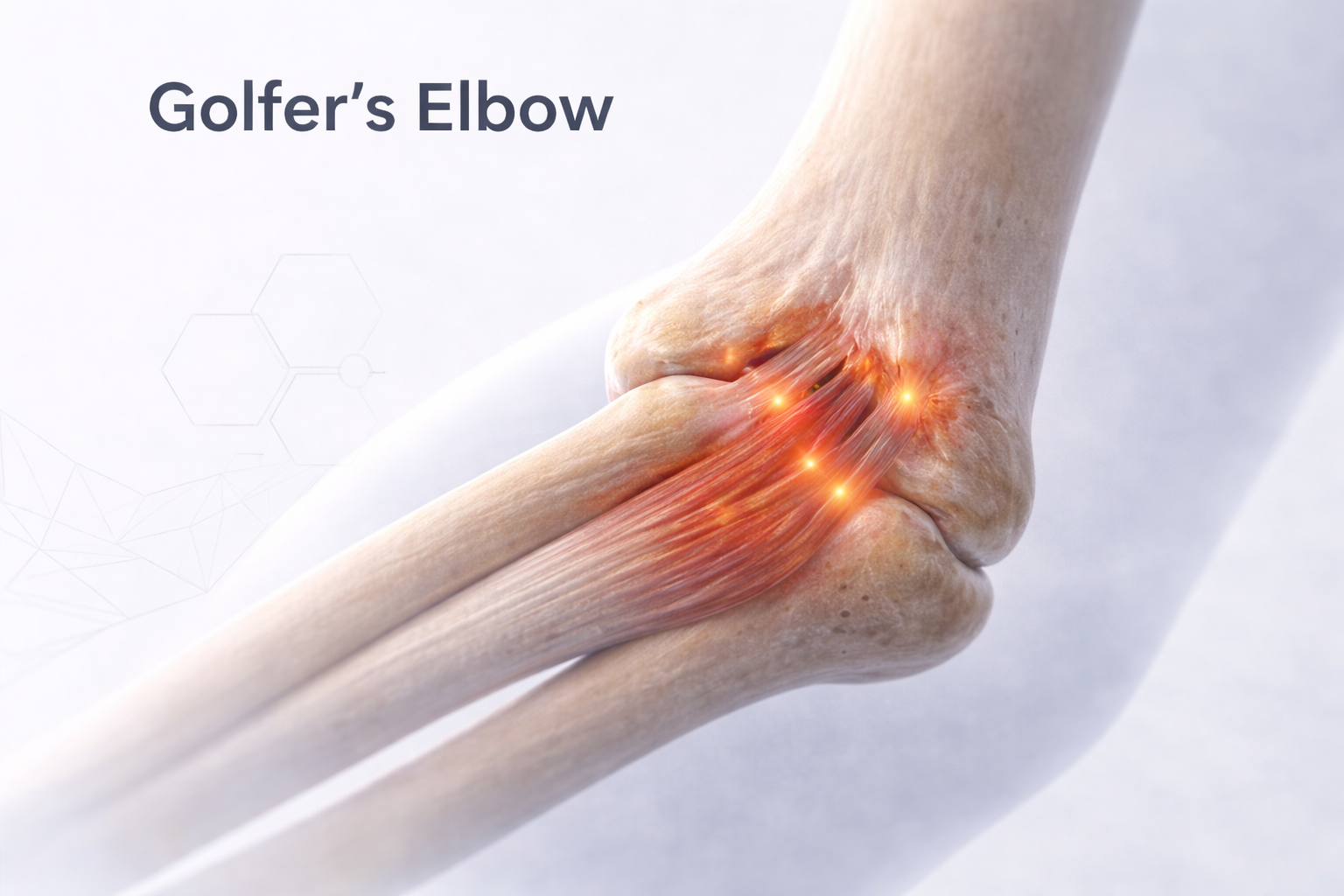
What is Golfer’s Elbow?
Golfer’s Elbow, or Medial Epicondylitis, is a painful condition that occurs due to inflammation or degeneration of the tendons that attach to the inner (medial) side of the elbow.
Despite its name, it isn’t limited to golfers — it can affect anyone performing repetitive wrist or forearm flexion, such as athletes, gym-goers, carpenters, and even computer users.
Patients typically report pain and tenderness on the inside of the elbow, radiating down the forearm, especially during gripping, throwing, or wrist flexion activities.
⚙️ How Does it Develop?
Repetitive bending (flexion) of the wrist or twisting of the forearm puts excessive strain on the common flexor tendonthat originates from the medial epicondyle.
This overuse leads to microtears and degeneration in the tendon, resulting in inflammation, pain, and reduced grip strength.
In some cases, improper gym or sports technique — such as forceful wrist curls, incorrect golf swing, or throwing mechanics — contributes to overloading the tendon.
⚠️ Common Causes & Risk Factors
- Repetitive wrist flexion or forearm rotation (golf, cricket, baseball, weight training)
- Improper lifting or sports technique
- Occupations involving repetitive gripping or manual work
- Poor ergonomics in desk or computer jobs
- Weak shoulder or core muscles altering load mechanics
- Age 35–60 years
- Coexisting neck or shoulder stiffness
🔬 Pathophysiology
Golfer’s Elbow involves degenerative changes (tendinosis) rather than acute inflammation.
Microscopic tendon injury causes fibroblast proliferation, collagen disorganization, and loss of tensile strength.
The most commonly affected structure is the flexor carpi radialis and pronator teres tendon origin at the medial epicondyle.
In severe or chronic cases, scar tissue forms, leading to persistent pain and reduced flexibility.
🧪 Investigations
- Clinical Examination:
- Tenderness at the medial epicondyle (inner elbow).
- Pain with resisted wrist flexion or forearm pronation.
- Grip weakness or stiffness in advanced cases.
- Imaging:
- Ultrasound: Shows tendon thickening, degeneration, or small tears.
- MRI: Used for chronic cases to evaluate tendon quality and rule out ulnar nerve entrapment or associated ligament injury.
💊 Management
🩹 Non-Surgical (Mainstay of Treatment)
- Activity Modification: Avoid repetitive strain or heavy gripping until pain improves.
- Medications: Anti-inflammatory drugs to reduce pain and swelling.
- Physiotherapy:
- Eccentric strengthening of flexor muscles.
- Stretching, dry needling, and shockwave therapy for chronic tendinosis.
- Scapular and postural correction to improve biomechanics.
- Bracing: Medial counterforce strap during activities to offload the tendon.
- Ultrasound-Guided Injections:
- PRP Injection: Stimulates natural healing and tendon regeneration.
- Corticosteroid Injection: For short-term relief in acute cases (use cautiously).
- Prolotherapy / BMAC: For chronic, resistant tendinopathy.
🩺 Surgical (If Symptoms Persist >6–9 Months)
- Arthroscopic or Mini-Open Debridement: Removal of degenerated tendon tissue and stimulation of new healing response.
- Tendon Repair / Reattachment: Restores normal tendon tension and function.
- Rehabilitation:
- Early gentle stretching followed by progressive strengthening.
- Full functional recovery usually within 2–3 months.
⏳ Sequelae if Left Untreated
- Chronic elbow pain and weakness
- Grip fatigue and loss of strength
- Extension of degeneration to wrist or shoulder tendons
- Ulnar nerve irritation (tingling in ring and little fingers)
- Persistent limitation in sports and daily activities
🌟 Prognosis
With accurate diagnosis and structured rehabilitation, 90% of patients recover fully without surgery.
PRP and biologic therapies have significantly improved outcomes, ensuring durable, long-term results and early return to sport.
💬 Key Takeaway
“Pain on the inner side of your elbow isn’t just from your swing — it’s your tendon asking for rest and repair.
With modern regenerative treatments, you can get back to your grip — stronger than before.”