


What is Elbow Dislocation & Instability?
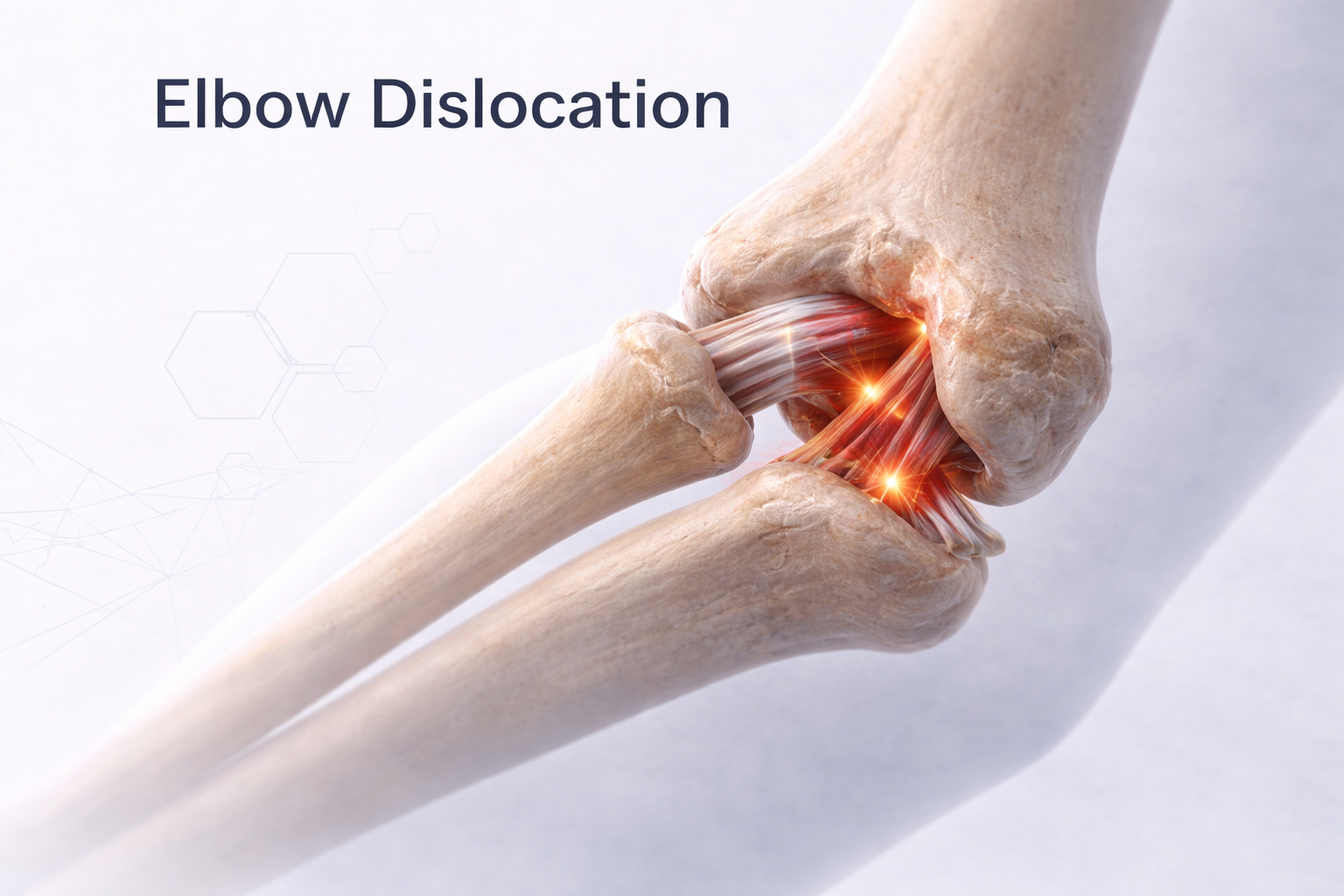
The elbow joint is a complex hinge joint formed by three bones — the humerus (upper arm), radius, and ulna (forearm).
An elbow dislocation occurs when these bones are forced out of alignment due to trauma.
When the supporting ligaments and soft tissues become stretched or torn, the joint may remain unstable even after relocation — this condition is known as Elbow Instability.
Patients usually present with sudden, severe pain, swelling, deformity, and inability to move the arm following a fall or injury. Chronic cases may describe a sense of looseness or the elbow “slipping” during movement or load-bearing.
⚙️ How Does it Develop?
Elbow dislocations usually result from a fall on an outstretched hand with the elbow slightly bent — a common mechanism in sports and road traffic accidents.
This force drives the forearm backward, tearing the stabilizing ligaments and sometimes fracturing the surrounding bones.
Elbow instability may develop after:
- Incomplete healing of ligaments after a dislocation, or
- Repeated stress injuries that gradually stretch the soft tissues.
🧩 Types of Elbow Dislocation
- Simple Dislocation:
- Only soft tissues (ligaments, capsule) are injured; no associated fracture.
- Most common and usually managed conservatively.
- Complex Dislocation:
- Involves associated fractures (radial head, coronoid process, or olecranon).
- Requires surgical intervention to restore anatomy and stability.
- Recurrent or Chronic Instability:
- Elbow repeatedly “gives way” or partially dislocates after an initial injury.
- May result from untreated ligamentous laxity or failed primary treatment.
⚠️ Risk Factors
- Fall on outstretched hand (sports, two-wheeler accidents)
- High-impact trauma or collision injuries
- Contact sports (wrestling, kabaddi, gymnastics)
- Prior elbow dislocation or ligament injury
- Generalized ligamentous laxity (hypermobile individuals)
- Inadequate post-injury rehabilitation
🔬 Pathophysiology
The ulnohumeral joint provides primary stability, while the collateral ligaments and muscles offer dynamic support.
- The Lateral Collateral Ligament (LCL) complex prevents posterolateral instability.
- The Medial Collateral Ligament (MCL) resists valgus stress.
When these are torn during dislocation, the joint becomes unstable.
In chronic instability, repeated subluxations cause cartilage wear, synovial irritation, and early arthritis — leading to pain and mechanical symptoms.
🧪 Investigations
- Clinical Examination:
- Visible deformity, swelling, and tenderness.
- Reduced or painful movement; instability on stress testing.
- Imaging:
- X-rays: Confirm direction and type of dislocation; identify fractures.
- CT Scan (3D): For detailed bony anatomy in complex cases.
- MRI: To evaluate ligament tears, cartilage damage, and chronic instability patterns.
💊 Management
🩹 Non-Surgical (For Simple Dislocations)
- Immediate Reduction: Under anesthesia or sedation to restore alignment.
- Immobilization: Short period (1–2 weeks) in a sling or brace for soft tissue healing.
- Early Physiotherapy:
- Essential to prevent stiffness and loss of motion.
- Gradual mobilization under supervision to restore strength and flexibility.
🩺 Surgical (For Complex or Recurrent Cases)
- Open or Arthroscopic Repair:
- Reconstruction of torn ligaments (MCL/LCL complex) using sutures or grafts.
- Fixation of associated fractures (radial head, coronoid, or olecranon).
- Elbow Stabilization: Temporary external fixator in severe instability.
- Rehabilitation:
- Early motion to prevent stiffness.
- Strengthening of flexor–extensor balance over 6–8 weeks.
- Return to sport or heavy activity after 3–4 months.
⏳ Sequelae if Left Untreated
- Chronic instability or recurrent subluxation
- Stiffness and loss of motion
- Heterotopic ossification (bone formation in soft tissues)
- Cartilage wear leading to post-traumatic arthritis
- Persistent pain and deformity
- Nerve injury (especially ulnar or median nerve entrapment)
🌟 Prognosis
With early reduction, stable fixation, and structured rehabilitation, most patients regain full elbow stability and range of motion.
Advanced ligament reconstruction techniques offer durable results and allow athletes to return to their pre-injury performance levels.
💬 Key Takeaway
“An elbow dislocation is not just about putting the joint back — it’s about restoring the perfect balance between stability and movement.
Early expert care ensures strength, confidence, and long-term protection against stiffness.”