


What is AC Joint Dislocation?
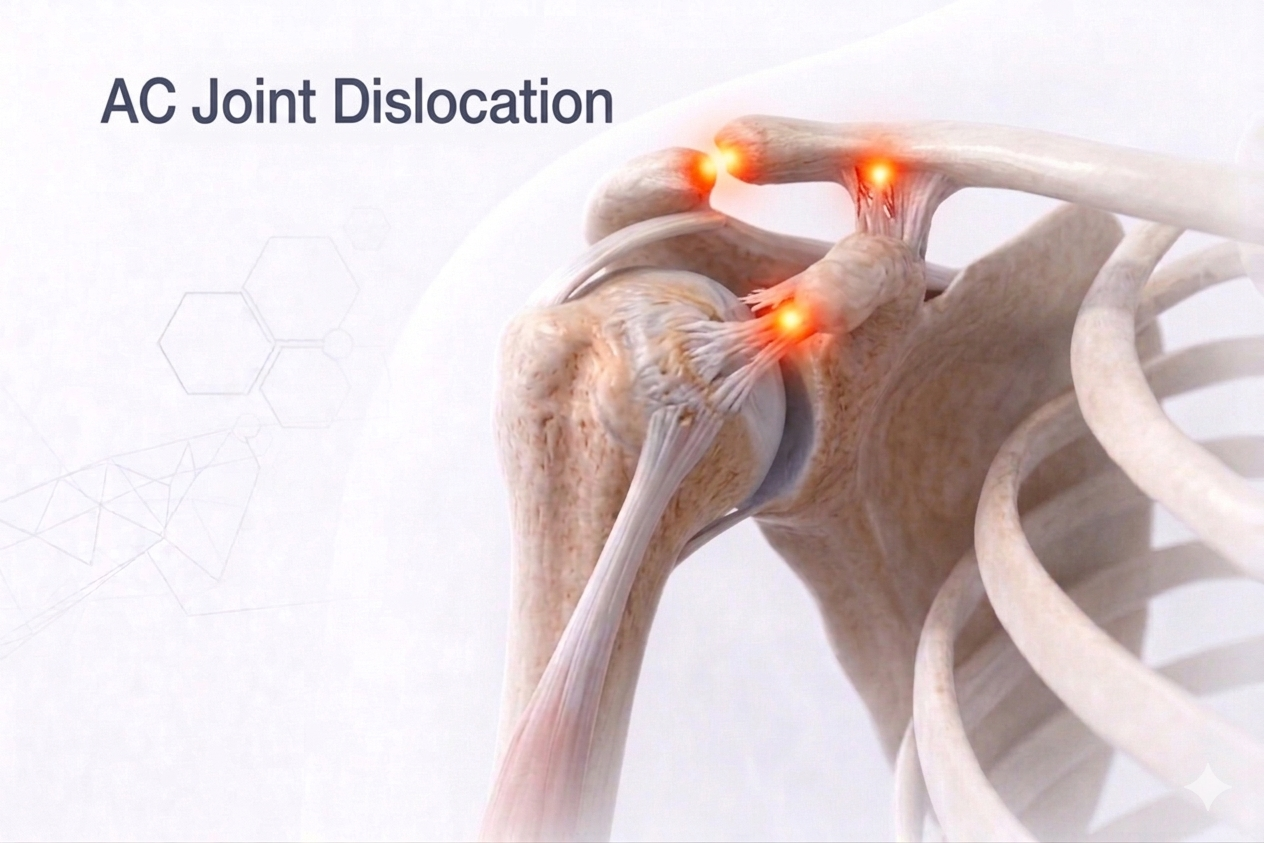
The Acromioclavicular (AC) joint connects the clavicle (collarbone) to the acromion — the outermost part of the shoulder blade.It is a small but crucial joint that allows smooth movement of the shoulder girdle during daily activities and sports.
An AC joint dislocation occurs when the ligaments supporting this joint are stretched or torn — leading to a visible bump over the shoulder, pain, and restricted movement.It is one of the most common injuries in contact sports, road traffic accidents, and falls directly onto the shoulder.
⚙️ How Does it Develop?
The typical mechanism involves a direct fall onto the tip of the shoulder with the arm adducted (close to the body).This force pushes the acromion downward, tearing the stabilizing ligaments (AC and coracoclavicular ligaments), allowing the collarbone to pop upward.Depending on the severity of ligament injury, the displacement of the clavicle varies — ranging from a mild sprain to a complete dislocation.
⚠️ Risk Factors
- Contact and collision sports (rugby, football, hockey, kabaddi)
- Cycling or motorbike accidents
- Falls on the shoulder or outstretched arm
- Previous shoulder trauma or instability
- Heavy lifting or direct blows during gym workouts
🔬 Anatomy & Pathophysiology
The AC joint is stabilized by:
- Acromioclavicular ligaments– provide horizontal stability.
- Coracoclavicular ligaments (conoid & trapezoid)– provide vertical stability.
When these ligaments tear:
- Partial tear → mild sprain or subluxation.
- Complete tear → visible deformity and functional loss.The surrounding muscles (trapezius and deltoid) may also get stripped off the clavicle end, aggravating the deformity.
🧩 Classification (Simplified Rockwood Grades)
Grade
| Description
| Key Findings
|
Type I
| Mild sprain of AC ligaments
| No visible deformity, mild tenderness
|
Type II
| Tear of AC ligament, partial CC tear
| Mild elevation of collarbone
|
Type III
| Complete tear of AC & CC ligaments
| Prominent bump over shoulder
|
Type IV–VI
| Complex dislocations with severe displacement
| Surgical category
|
🧪 Investigations
- Clinical Examination:
- Tenderness and step deformity over AC joint.
- Pain during cross-body adduction test.
- Imaging:
- X-rays (Zanca View):Best for assessing joint alignment and displacement.
- Stress X-rays:Sometimes done to compare both shoulders.
- MRI (if needed):For associated ligament or muscle injuries.
💊 Management
🩹 Non-Surgical (Grades I & II, select Type III)
- Rest & Sling:Immobilization for 2–3 weeks.
- Cold therapy & Pain control:Anti-inflammatory medications.
- Physiotherapy:
- Gradual shoulder mobilization after pain subsides.
- Focus on scapular stabilization and rotator cuff strengthening.
- Return to Sports:Usually within 4–6 weeks.
🩺 Surgical (Grades III with high demand / IV–VI)
- Arthroscopic or Open Reconstruction:
- AC and coracoclavicular ligament repair or reconstruction using suture anchors or grafts.
- In high-demand athletes or laborers, anatomic ligament reconstructionensures lasting stability.
- Rehabilitation:
- Sling for 3–4 weeks → gradual ROM → strengthening at 6–8 weeks.
- Full recovery by 3–4 months.
⏳ Sequelae if Left Untreated
- Persistent deformity (“step-off” at collarbone)
- Chronic pain or tenderness at the joint
- Shoulder weakness and fatigue
- Difficulty lifting or carrying weights overhead
- Post-traumatic AC joint arthritis
- In high-grade cases — functional and cosmetic dissatisfaction
🌟 Prognosis
With modern minimally invasive techniques, arthroscopic AC joint reconstruction offers excellent cosmetic and functional results.Most patients regain full strength, shoulder balance, and can resume sports or heavy activity within 3–4 months.
💬 Key Takeaway
“That small bump on your shoulder might look harmless — but untreated AC joint dislocation can silently limit your strength and stability. Early correction ensures lasting performance and confidence.”