

What is a Monteggia Fracture–Dislocation?
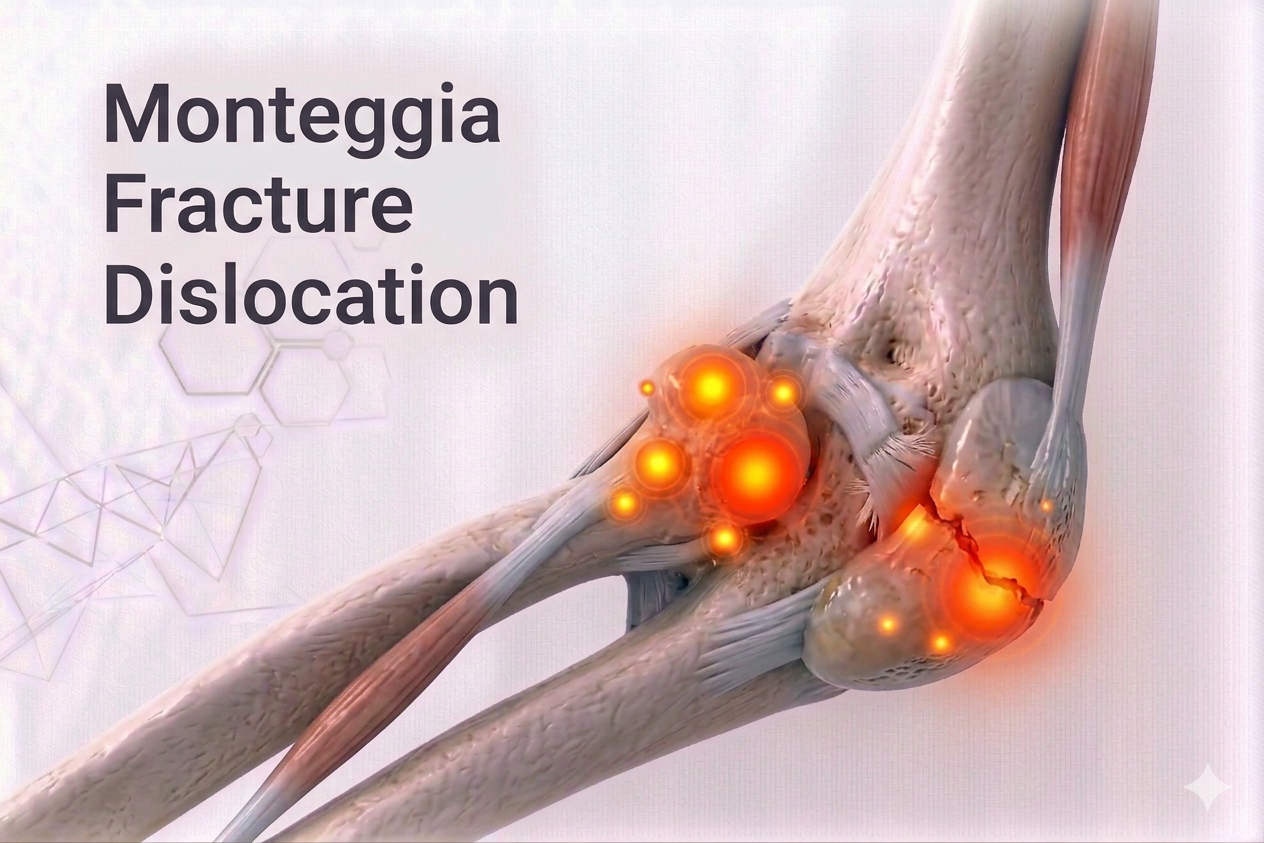
A Monteggia Fracture–Dislocation is a complex injury that involves a fracture of the ulna (one of the forearm bones)combined with a dislocation of the radial head at the elbow joint.It disrupts the normal relationship between the two forearm bones and the elbow, leading to instability, pain, and restricted movement.
This is a serious injury that requires accurate diagnosis and timely treatment to restore normal function and prevent long-term disability.
⚙️ How Does it Develop?
Monteggia injuries usually occur due to high-energy trauma such as a fall on an outstretched hand, road traffic accidents, or direct blows to the forearm.The mechanism varies:
• A fall with the forearm in pronation and the elbow extended may force the radial head to dislocate anteriorly.
• A direct blow to the forearm may cause fracture of the ulna with associated dislocation of the radius.
Improper or delayed diagnosis can result in chronic Monteggia lesions, which are challenging to treat and can lead to permanent dysfunction.
⚠️ Common Causes & Risk Factors
• Fall on an outstretched hand (especially in children)
• Road traffic accidents or sports trauma
• Direct impact on the forearm
• Improperly managed forearm fractures
• Rarely, repetitive microtrauma in pediatric throwing athletes
🔬 Pathophysiology
The injury involves:
• A fracture of the proximal or midshaft of the ulna, which loses its alignment and length.
• A dislocation of the radial head from its normal articulation with the capitellum of the humerus.
Because the radius and ulna function as a single unit, the loss of ulnar alignment directly affects the radial head position.Restoration of ulnar length and contour is critical for stable reduction of the radial head.
If untreated or missed, the radial head may remain dislocated, causing chronic pain, stiffness, and loss of forearm rotation.
🧩 Monteggia Fracture Classification (Bado Classification)
Type
Direction of Radial Head Dislocation
Typical Mechanism
Type I
Anterior dislocation
Most common (60%); fall on outstretched hand with forearm pronated
Type II
Posterior / posterolateral
Direct blow to the back of the forearm
Type III
Lateral
Seen in children; valgus stress injury
Type IV
Anterior dislocation + fracture of both radius and ulna
High-energy trauma
🧪 Investigations
1. Clinical Examination:
o Pain, swelling, and deformity of the forearm and elbow.
o Restricted rotation and flexion-extension.
o Prominent radial head on the outer side of the elbow.
1. Imaging:
o X-rays: Forearm and elbow in AP and lateral views — to confirm both ulnar fracture and radial head position.
o CT Scan: Useful for complex or comminuted fractures.
o MRI: Occasionally used to evaluate soft-tissue injury or chronic cases.
💊 Management
🩹 Non-Surgical (Rare – for Children with Stable Reduction)
• Only in very young children (<8 years) with minimal displacement.
• Closed reduction of the ulna followed by immobilization in flexion and supination.
• Frequent X-ray monitoring to ensure maintained alignment.
🩺 Surgical (Mainstay of Treatment for Adults & Unstable Injuries)
• Open Reduction and Internal Fixation (ORIF):
o Anatomical reduction and fixation of the ulnar fracture using plates and screws.
o Once the ulna is restored, the radial head often reduces spontaneously.
• Direct Reduction of Radial Head:
o If persistent dislocation remains, open reduction may be required.
• Ligament Repair:
o Reconstruction of the annular ligament for stability if torn.
• Rehabilitation:
o Early physiotherapy once fixation is stable.
o Progressive strengthening and range-of-motion exercises from 2–3 weeks.
o Full recovery expected in 3–4 months.
⏳ Sequelae if Left Untreated
• Chronic radial head dislocation
• Restricted rotation (pronation/supination)
• Persistent elbow instability
• Malunion or nonunion of the ulna
• Nerve injury (especially posterior interosseous nerve palsy)
• Early degenerative arthritis
🌟 Prognosis
When recognized early and managed correctly, Monteggia fractures have excellent outcomes.Timely anatomic restoration of the ulna and guided rehabilitation allow return to full elbow and forearm function.Missed or neglected injuries, however, often require complex reconstructive surgery.
💬 Key Takeaway
“In elbow trauma, what’s seen on X-ray isn’t always the full story — a missed Monteggia lesion can change the elbow forever.Early detection and expert fixation restore both motion and confidence.”

Demo@gmail.com

+91 9979076644 / +91 9372952726