
What is a Radial Head Fracture?
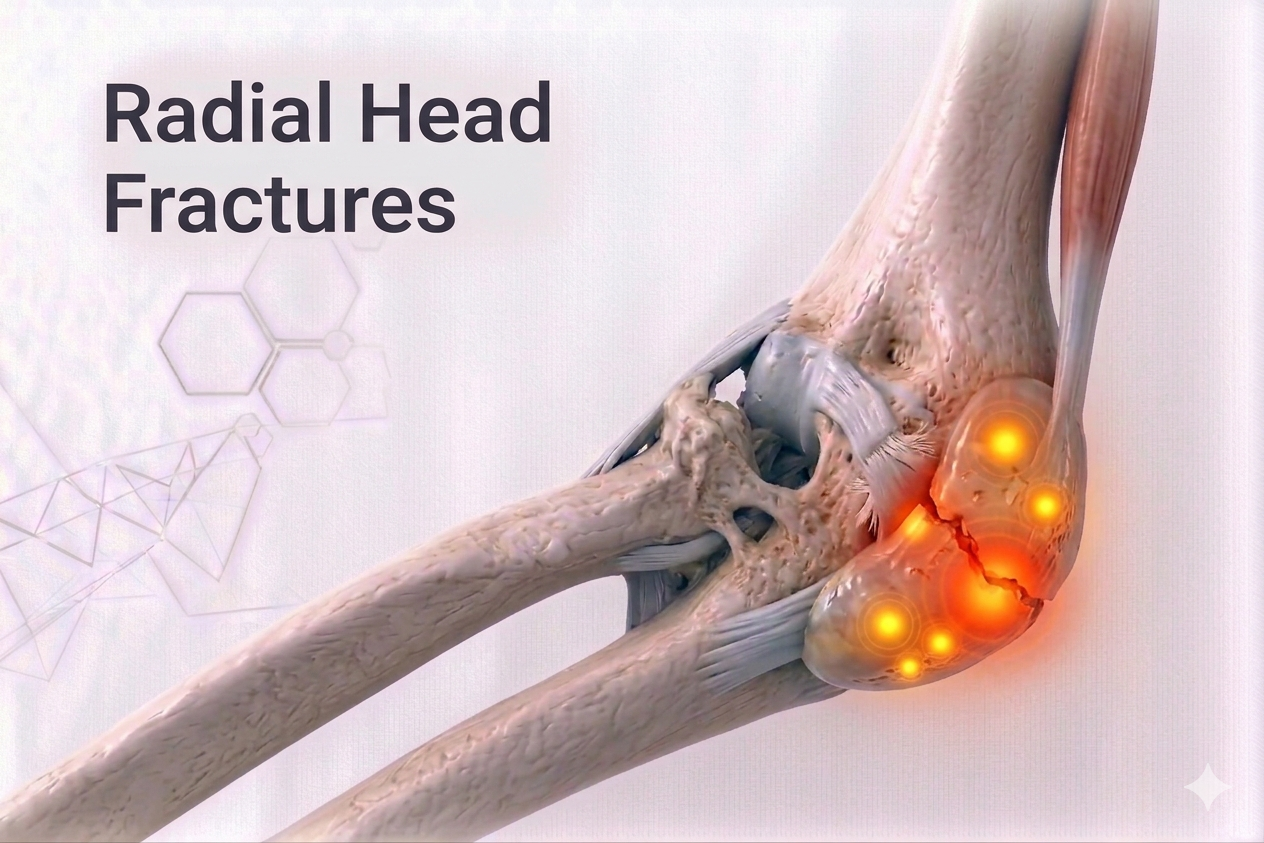
The radial head is the upper part of the radius bone in the forearm, forming one of the key components of the elbow joint.A Radial Head Fracture occurs when this bony structure cracks or breaks, usually after a fall on an outstretched handwith the elbow partially bent.It is one of the most common elbow fractures in adults and can significantly impact forearm rotation and elbow stability.
Patients often present with pain, swelling, and inability to rotate the forearm (turning the palm up or down) after a fall or direct trauma.
⚙️ How Does it Develop?
When you fall on your hand, the impact force travels up the forearm to the elbow.The radial head bears this load and gets compressed against the humerus — leading to a fracture.The injury may range from a small crack (hairline fracture) to a comminuted (multi-piece) break involving the joint surface.
In high-impact cases, radial head fractures may occur along with elbow dislocation, ligament injury, or coronoid fracture — forming the “terrible triad” of the elbow.
⚠️ Common Causes & Risk Factors
• Fall on an outstretched hand
• Direct blow to the outer elbow
• Sports-related trauma (cricket, cycling, skating)
• Road traffic accidents
• Osteoporosis or weakened bone quality
🔬 Pathophysiology
The radial head plays a crucial role in:
• Forearm rotation (supination and pronation)
• Elbow stability (lateral column support)
• Load transmission between the wrist and elbow
A fracture disrupts these functions, leading to pain, mechanical block, and instability.Untreated or improperly managed fractures may lead to stiffness, arthritis, or chronic instability.
🧩 Mason Classification (Simplified)
Type
Description
Management Approach
Type I
Non-displaced or minimally displaced fracture
Non-surgical (immobilization & physiotherapy)
Type II
Displaced (>2 mm) or mechanical block to rotation
May require fixation (screws or plates)
Type III
Comminuted (multi-fragmented) fracture
Surgical – radial head fixation or replacement
Type IV
Radial head fracture with elbow dislocation
Surgical – reconstruction with ligament repair
🧪 Investigations
1. Clinical Examination:
o Pain, swelling, and tenderness on the outer side of the elbow.
o Limited motion, especially forearm rotation.
o Check for associated instability or nerve symptoms.
1. Imaging:
o X-ray (AP & Lateral Views): Identifies fracture type and displacement.
o CT Scan (3D): Provides detailed visualization for surgical planning.
o MRI (if needed): Evaluates associated ligament or cartilage injuries.
💊 Management
🩹 Non-Surgical (For Type I and Stable Type II Fractures)
• Immobilization: Short arm sling or splint for 1–2 weeks.
• Pain Control: Anti-inflammatory medications and ice application.
• Early Physiotherapy:
o Gentle range-of-motion exercises begin as soon as pain allows.
o Prevents stiffness and ensures full functional recovery.
🩺 Surgical (For Type II with Block, Type III & IV Fractures)
• Open Reduction and Internal Fixation (ORIF):
o Fragments are realigned and fixed with screws or low-profile plates.
• Radial Head Replacement (Arthroplasty):
o In complex or comminuted fractures where fixation isn’t possible.
o Provides stability and prevents long-term arthritis.
• Ligament Repair (if Instability Present):
o Particularly for “terrible triad” injuries involving radial head, coronoid, and ligament disruption.
• Rehabilitation:
o Early motion starts within a few days post-surgery.
o Progressive strengthening from 6–8 weeks.
o Full recovery typically by 3–4 months.
⏳ Sequelae if Left Untreated
• Persistent stiffness and limited rotation
• Chronic elbow instability
• Post-traumatic arthritis
• Malunion or nonunion
• Secondary deformity or weakness in grip and lifting
🌟 Prognosis
With early and appropriate treatment, most patients regain near-complete range of motion and strength.Modern fixation and arthroplasty techniques offer excellent outcomes, allowing patients to return to normal work and sports within months.
💬 Key Takeaway
“A small fracture in the radial head can have a big impact on elbow function.Timely diagnosis, stable fixation, and early mobilization are key to a strong, flexible recovery.”

Demo@gmail.com

+91 9979076644 / +91 9372952726