

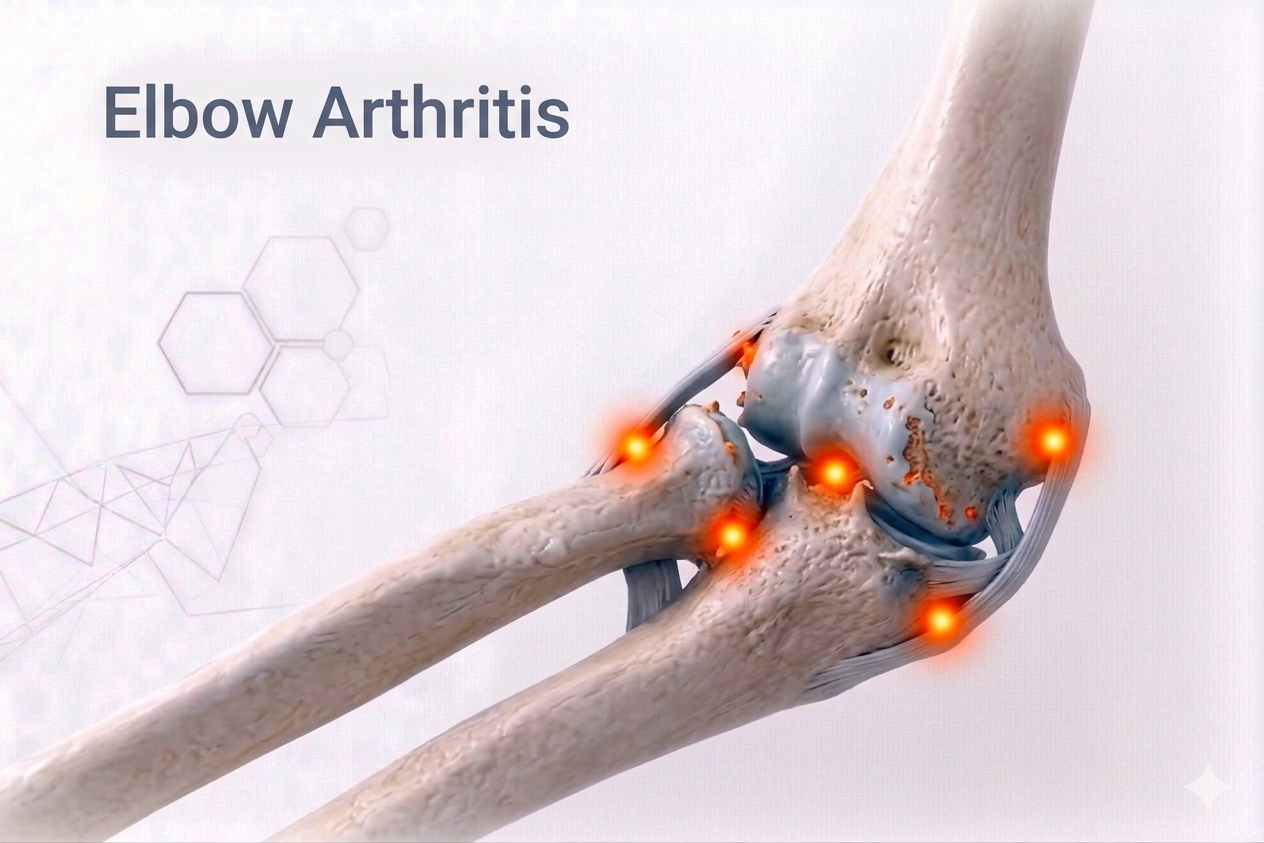
What is Elbow Arthritis?
Elbow Arthritis refers to the gradual wear and tear of the joint cartilage between the upper arm bone (humerus) and forearm bones (ulna and radius).As the smooth cartilage wears down, bones start rubbing against each other, leading to pain, stiffness, swelling, and loss of movement in the elbow joint.
Unlike knee or hip arthritis, elbow arthritis is less common — but when it occurs, it can severely affect daily activities like eating, grooming, or lifting objects.
⚙️ How Does it Develop?
Elbow arthritis may develop gradually due to age-related degeneration, repetitive stress, or as a consequence of previous injury.In some patients, it follows a fracture, dislocation, or long-standing inflammatory disease (such as rheumatoid arthritis).The loss of cartilage results in friction between bones, triggering inflammation, stiffness, and progressive joint deformity.
🧩 Types of Elbow Arthritis
1. Primary Osteoarthritis:
o Caused by natural aging and repetitive mechanical stress.
o Common in heavy laborers or athletes.
1. Post-Traumatic Arthritis:
o Develops after a previous elbow fracture or dislocation.
o Irregular joint surfaces accelerate cartilage wear.
1. Inflammatory Arthritis (e.g., Rheumatoid):
o Autoimmune inflammation damages cartilage and bone.
1. Crystal Arthropathy (e.g., Gout):
o Deposition of uric acid crystals causes joint inflammation and damage.
⚠️ Risk Factors
• Age > 40 years
• History of elbow fracture or dislocation
• Heavy lifting or repetitive occupational stress
• Inflammatory or autoimmune disease
• Genetic predisposition
• Inadequate rehabilitation after trauma
🔬 Pathophysiology
The elbow’s cartilage gradually degenerates due to chronic overload or previous trauma.The body responds by forming osteophytes (bone spurs) and synovial inflammation, further narrowing the joint space.Loose bodies may form within the joint, causing catching or locking sensations.Over time, stiffness increases and movement becomes progressively restricted.
🧪 Investigations
1. Clinical Examination:
o Pain, swelling, and reduced range of motion.
o Grating or “locking” sensation during movement.
o Bony enlargement or deformity in advanced cases.
1. Imaging:
o X-rays: Show joint space narrowing, bone spurs, and loose fragments.
o CT Scan: Defines extent of bone overgrowth or loose bodies.
o MRI: Used to assess cartilage condition and synovial inflammation.
💊 Management
🩹 Non-Surgical (Initial Line of Treatment)
• Medications: Anti-inflammatory and pain-relieving drugs.
• Activity Modification: Avoid repetitive lifting or pushing.
• Physiotherapy:
o Gentle range-of-motion and stretching exercises.
o Strengthening to preserve flexibility and function.
• Injections:
o Viscosupplementation (Hyaluronic acid) for lubrication.
o Corticosteroid or PRP injections to reduce inflammation and pain.
• Bracing:
o Elbow support brace may help reduce stress during activity.
🩺 Surgical (For Severe or Refractory Cases)
• Arthroscopic Debridement:
o Minimally invasive procedure to remove bone spurs and loose bodies, improving motion.
• Osteophyte Excision / Contracture Release:
o Relieves impingement and improves extension.
• Total Elbow Replacement (TER):
o Recommended for advanced degeneration or inflammatory arthritis.
o Provides excellent pain relief and functional restoration in low-demand patients.
• Postoperative Rehabilitation:
o Early physiotherapy to regain motion and strength.
o Gradual return to functional activity within 6–8 weeks.
⏳ Sequelae if Left Untreated
• Persistent pain and stiffness
• Progressive loss of motion
• Locking or catching due to loose fragments
• Joint deformity and crepitus
• Difficulty performing routine tasks (eating, grooming, lifting)
• Eventual joint destruction requiring complex surgery
🌟 Prognosis
Modern arthroscopic and replacement techniques offer excellent long-term outcomes.With early diagnosis and comprehensive rehabilitation, most patients can return to daily activity with minimal pain and near-normal motion.
💬 Key Takeaway
“Elbow arthritis may be rare — but its impact on daily life is real.With timely diagnosis and precision treatment, pain-free movement is always within reach.”

Demo@gmail.com

+91 9979076644 / +91 9372952726