



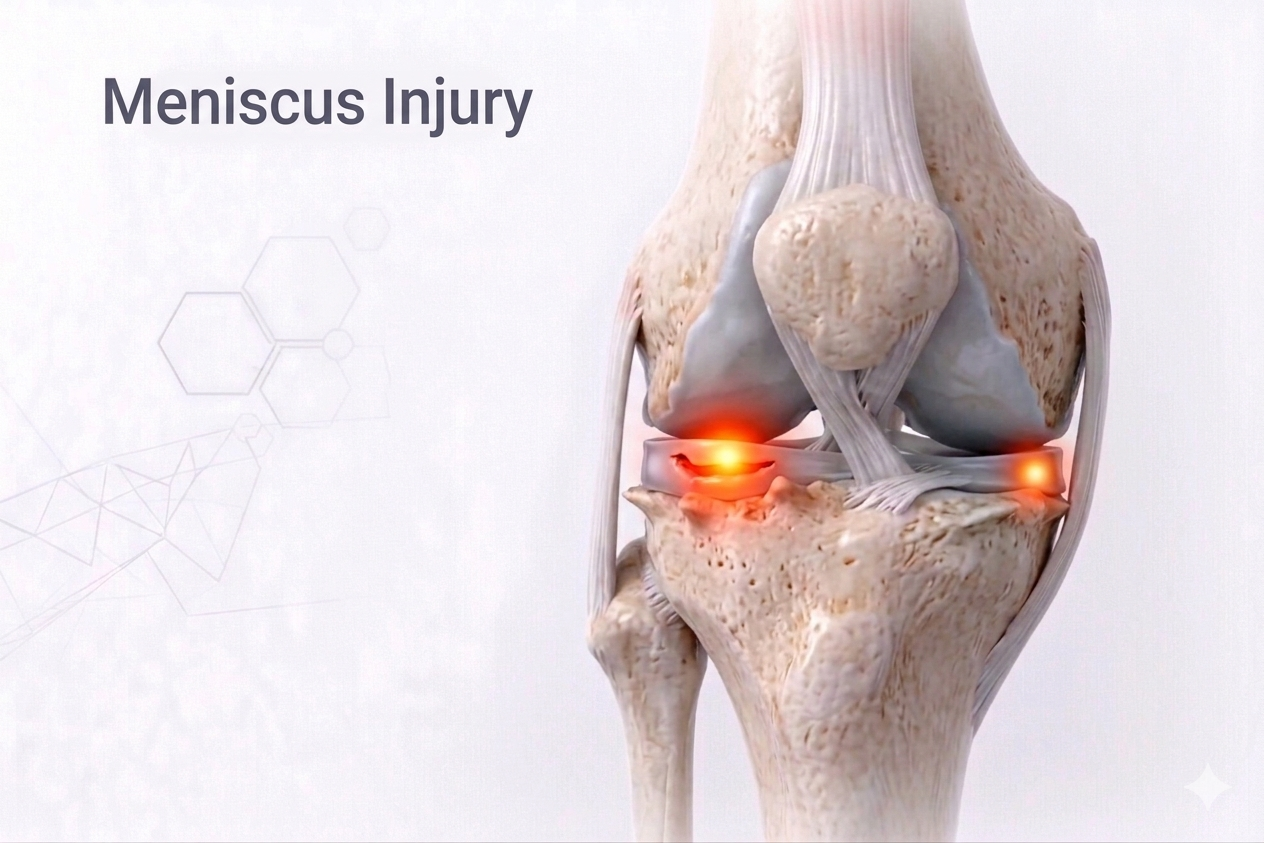
What is a Meniscus Tear?
The meniscus is a crescent-shaped, rubbery cartilage pad inside the knee that acts as a shock absorber, stabilizer, and lubricator between the femur (thigh bone) and tibia (shin bone).Each knee has two — a medial (inner) and a lateral (outer) meniscus.
A Meniscus Tear occurs when this cartilage is torn or frayed due to twisting, pivoting, or direct trauma.It can cause pain, swelling, locking, and a feeling of the knee “catching” or “giving way.”
⚙️ How Does it Develop?
- Traumatic Tears:Common in athletes during twisting, pivoting, or sudden change of direction — often associated with ACL injuries.
- Degenerative Tears:Seen in middle-aged and elderly individuals due to age-related wear and tear, even with minor movement.
Depending on the pattern and location, tears can range from small stable flaps to large displaced bucket-handle types.
⚠️ Risk Factors
- Contact or pivoting sports (football, basketball, cricket)
- Sudden twisting or squatting movement
- Poor quadriceps and hamstring balance
- Advanced age and cartilage degeneration
- Previous ligament injury or knee instability
🔬 Pathophysiology
The meniscus is divided into three zones based on blood supply:
- Red-Red Zone (Outer):Good blood supply — tears here can heal with repair.
- Red-White Zone (Middle):Moderate supply — selective repair possible.
- White-White Zone (Inner):Avascular — poor healing, may require trimming.
Tears alter load distribution, leading to increased pressure on joint cartilage and accelerated osteoarthritis if untreated.
🧩 Types of Meniscus Tears
- Vertical / Longitudinal
- Bucket Handle (Displaced fragment causing locking)
- Radial / Parrot-Beak
- Horizontal Cleavage
- Complex / Degenerative
- Root Tear (detachment from its attachment point)— a serious injury leading to loss of meniscal function.
🧪 Investigations
- Clinical Examination:
- Joint-line tenderness.
- McMurray’s or Thessaly Test:Pain or click on rotation.
- Swelling, catching, or intermittent locking.
- Imaging:
- X-ray:Usually normal; rules out bone injury.
- MRI:Gold standard for confirming tear pattern, size, and location.
💊 Management
🩹 Non-Surgical (Small / Degenerative Tears)
- RICE Protocol:Rest, Ice, Compression, Elevation.
- Medications:Anti-inflammatory drugs for pain and swelling.
- Physiotherapy:
- Strengthening of quadriceps and hamstrings.
- Focus on flexibility and joint stability.
- Injections:PRP or Hyaluronic Acid for pain relief in degenerative tears.
🩺 Surgical (For Large / Displaced / Unstable Tears)
Performed arthroscopically (keyhole surgery):
- Meniscus Repair:
- Preserves native tissue — indicated in younger patients and vascular zone tears.
- Techniques: All-inside, inside-out, or outside-in suturing.
- Partial Meniscectomy:
- Trimming of unstable or avascular tears.
- Focus on preserving as much meniscus as possible.
- Meniscus Root Repair / Transplant:
- For root avulsions or severe deficiency.
- Restores joint biomechanics and prevents early arthritis.
Rehabilitation:
- Early motion with brace protection for repaired tears.
- Strengthening from 4–6 weeks.
- Return to sport in 3–6 months depending on tear type and repair.
⏳ Sequelae if Left Untreated
- Persistent pain and swelling
- Recurrent locking and giving way
- Accelerated cartilage wear and osteoarthritis
- Irreversible loss of shock absorption
- Need for early knee replacement
🌟 Prognosis
Modern arthroscopic repair and biologic augmentation allow excellent outcomes — >90% healing rates in vascular zone tears.Preserving meniscus integrity ensures long-term joint protection and performance longevity for athletes.
💬 Key Takeaway
“The meniscus is the knee’s shock absorber — repair it when you can, protect it always.Early intervention preserves both performance and joint longevity.”