



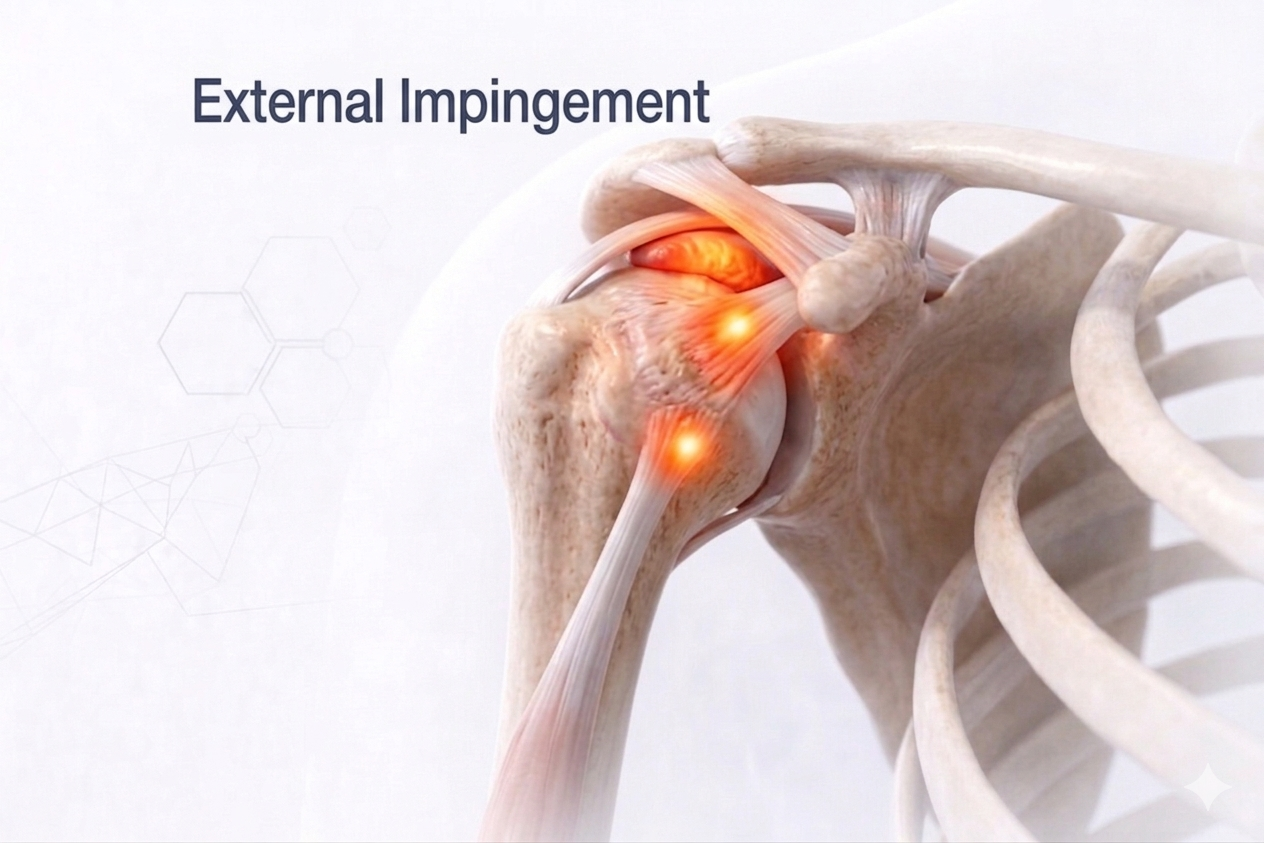
🔍 What is External Impingement?
External impingement is the most common type of shoulder impingement, where the rotator cuff tendons and subacromial bursa get compressed between the humeral head and the acromion.
This leads to pain, inflammation, and gradual tendon damage, especially during overhead movements.
⚙️ How Does it Develop?
The subacromial space becomes narrowed due to:
- Structural factors (bone shape, spurs)
- Functional issues (poor posture, muscle imbalance)
Repeated overhead activity causes mechanical compression, resulting in:
- Bursitis (inflamed bursa)
- Tendinitis (inflamed rotator cuff)
- Progressive tendon degeneration
⚠️ Common Causes
- Hooked or curved acromion
- Bone spurs (osteophytes)
- Thickened or inflamed bursa
- Rotator cuff weakness
- Poor scapular mechanics
- Repetitive overhead use (sports or occupation)
👥 Who is at Risk?
- Overhead athletes (cricket, badminton, swimming)
- Gym-goers (improper lifting technique)
- Painters, electricians, manual workers
- Desk workers with poor posture
- Middle-aged individuals (degenerative changes)
🧠 Pathophysiology
- Narrowing of subacromial space → tendon compression
- Repeated friction → inflammation (bursitis/tendinitis)
- Chronic stress → micro-tears in rotator cuff
- Advanced stage → partial or full-thickness rotator cuff tear
🔴 Symptoms
- Pain while lifting arm (especially 60°–120° painful arc)
- Difficulty reaching overhead or behind the back
- Pain during dressing (shirt, bra, etc.)
- Night pain (worse when lying on affected side)
- Weakness in shoulder over time
🧪 Clinical Tests
- Neer’s Impingement Test (pain on forced elevation)
- Hawkins–Kennedy Test (pain on internal rotation)
- Painful Arc Sign
- Jobe’s Test (supraspinatus weakness)
🔬 Investigations
- X-ray → Detects bone spurs, acromion shape
- Ultrasound → Shows bursitis or tendon inflammation
- MRI → Confirms rotator cuff damage and severity
💊 Management
🩹 Non-Surgical Treatment
- Activity modification (avoid overhead strain)
- Posture correction (especially rounded shoulders)
- Physiotherapy:
- Rotator cuff strengthening
- Scapular stabilization
- Stretching tight muscles (pectoralis)
- Anti-inflammatory medications
- Corticosteroid or PRP injections (if persistent pain)
🩺 Surgical Treatment
(If no improvement after 3–6 months)
- Arthroscopic Subacromial Decompression:
- Removal of bone spurs
- Bursectomy (removal of inflamed bursa)
- Rotator cuff repair (if tear present)
⏳ If Left Untreated
- Chronic shoulder pain
- Persistent bursitis
- Progressive rotator cuff tear
- Weakness and reduced range of motion
- Development of cuff tear arthropathy
🌟 Prognosis
- Excellent with early diagnosis and physiotherapy
- Most patients regain full function without surgery
- Surgical outcomes are highly successful when needed
💬 Key Takeaway
“External impingement is a mechanical problem with a biological consequence —
fix the movement early, and you prevent long-term tendon damage.”