



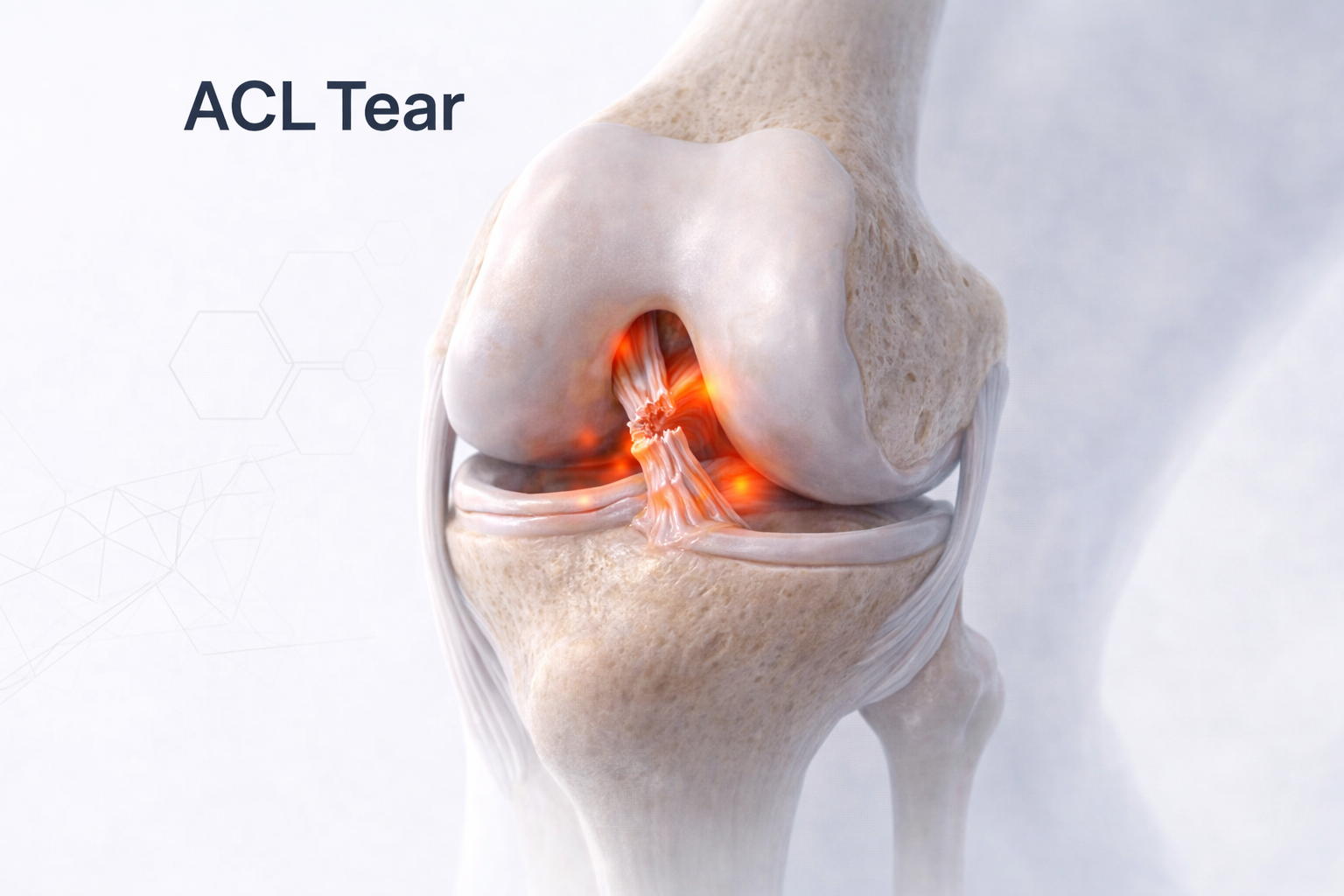
What is an ACL Tear?
The Anterior Cruciate Ligament (ACL) is one of the main stabilizing ligaments of the knee, preventing the tibia (shin bone) from sliding forward relative to the femur (thigh bone).
An ACL Tear occurs when this ligament is stretched beyond its limit or ruptured — commonly during sports involving sudden stops, pivots, or jumps such as football, basketball, cricket, or skiing.
Patients often describe hearing or feeling a “pop” at the time of injury, followed by immediate pain, swelling, and knee instability — the feeling that the knee might “give way.”
⚙️ How Does it Develop?
Most ACL injuries occur due to non-contact mechanisms — sudden deceleration, pivoting, or awkward landing — rather than direct collision.
Less commonly, they occur with a contact force driving the knee inward (valgus) or outward (varus).
The ACL may tear partially or completely, and in some cases, is associated with injuries to the meniscus, MCL, or cartilage.
⚠️ Risk Factors
- High-intensity pivoting or cutting sports
- Poor landing mechanics or weak core/hip control
- Female athletes (due to hormonal and biomechanical factors)
- Previous knee injury
- Flat-foot alignment or ligamentous laxity
🔬 Pathophysiology
The ACL consists of two bundles — anteromedial and posterolateral — working together to control anterior translation and rotational stability of the knee.
When the ligament ruptures:
- The mechanoreceptors within it lose proprioceptive feedback.
- Secondary stabilizers (muscles and menisci) undergo strain.
- The knee becomes rotationally unstable, predisposing to secondary cartilage and meniscus damage.
🧪 Investigations
- Clinical Examination:
- Positive Lachman’s Test, Anterior Drawer Test, or Pivot Shift Test.
- Joint effusion and limited range of motion.
- Imaging:
- X-rays: Rule out associated fractures (Segond fracture).
- MRI: Gold standard for confirming partial or complete ACL tear and associated meniscus/chondral lesions.
💊 Management
🩹 Non-Surgical (Partial Tear or Low-Demand Patients)
- Activity Modification: Avoid high-impact sports.
- Physiotherapy: Focus on quadriceps and hamstring strengthening, neuromuscular control, and proprioception.
- Bracing: Functional knee brace for stability during daily activities.
- Injections: PRP or stem cell injections in select partial tears for healing support.
🩺 Surgical (Complete Tear or Active Individuals)
- Arthroscopic ACL Reconstruction:
- The torn ligament is replaced with a tendon graft (usually hamstring, patellar tendon, or quadriceps tendon).
- The graft is fixed within bone tunnels using screws or buttons for stability.
- Graft Choices:
- Autograft: From patient’s own tissue (preferred for athletes).
- Allograft: Donor tissue (used in revisions or multiple ligament injuries).
- Rehabilitation:
- Early motion from Day 1.
- Strength training by 6–8 weeks.
- Running by 4–5 months.
- Return to sport at 9–12 months.
⏳ Sequelae if Left Untreated
- Recurrent knee instability
- Meniscus and cartilage damage
- Early-onset osteoarthritis
- Reduced athletic performance and confidence
- Chronic pain and swelling
🌟 Prognosis
With modern arthroscopic reconstruction and structured physiotherapy, over 90% of patients regain full knee stability and return to sports.
Graft choice, surgical precision, and patient commitment to rehab are key predictors of outcome.
💬 Key Takeaway
“An ACL tear doesn’t have to end your game — but early diagnosis, right graft choice, and disciplined rehab can decide how soon you’re back on the field.”