



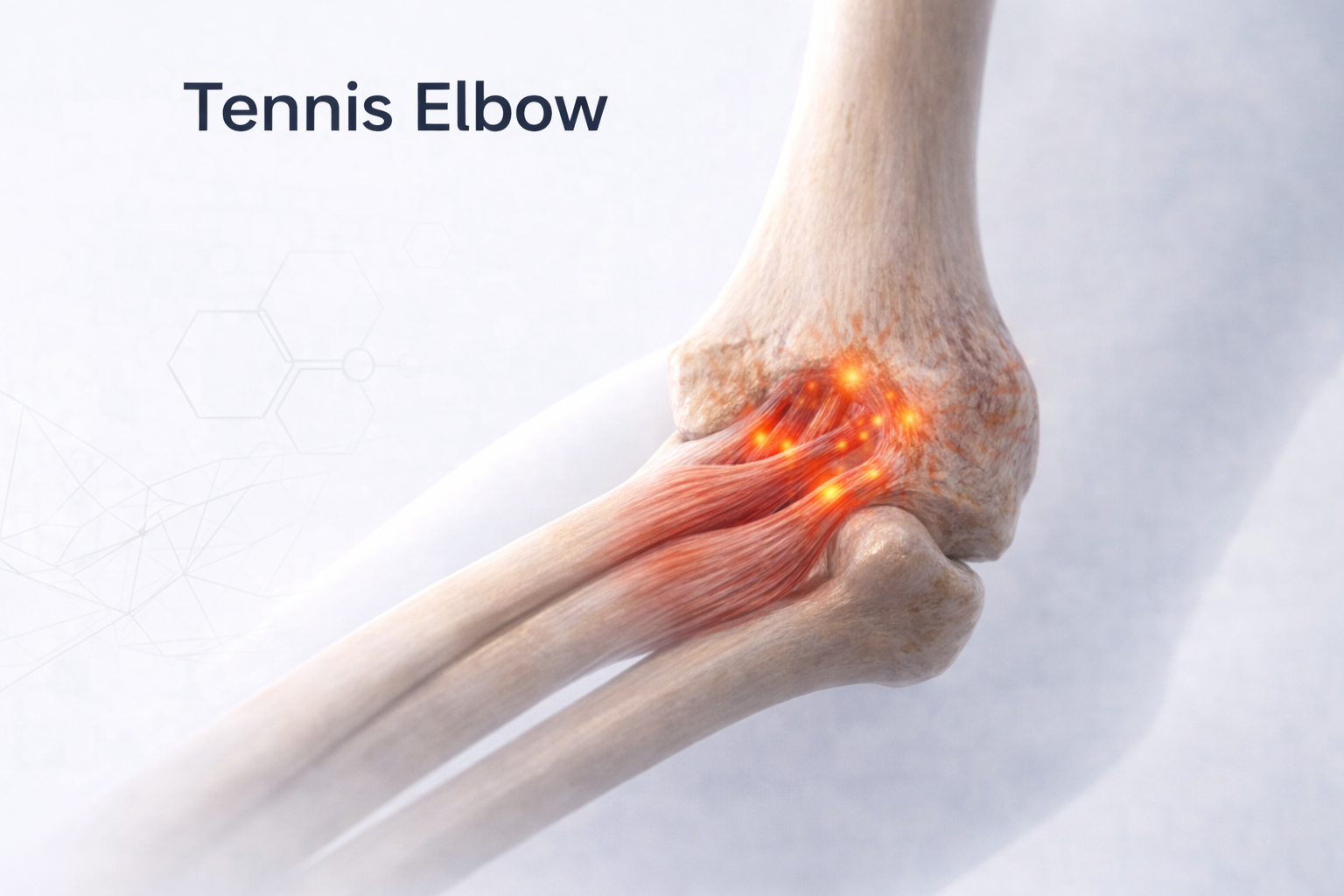
What is Tennis Elbow?
Tennis Elbow, or Lateral Epicondylitis, is a painful condition caused by inflammation or microtears in the tendons that attach to the outer (lateral) part of the elbow.
Despite its name, it isn’t limited to tennis players — it commonly affects anyone performing repetitive wrist or forearm movements, such as athletes, gym-goers, office workers, and manual laborers.
Patients typically experience pain on the outer side of the elbow, especially while lifting, gripping, or twisting movements like turning a doorknob or holding a cup.
⚙️ How Does it Develop?
Tennis Elbow results from repetitive stress and overuse of the forearm extensor muscles — particularly the extensor carpi radialis brevis (ECRB).
Continuous microtrauma causes tiny tendon tears near the lateral epicondyle, triggering inflammation and degeneration.
Over time, if untreated, the tendon loses its ability to heal, resulting in chronic pain and weakness.
⚠️ Common Causes & Risk Factors
- Repetitive wrist or forearm movements (typing, racquet sports, gym workouts)
- Improper sports technique or overtraining
- Poor ergonomics in computer use or lifting
- Middle age (40–60 years)
- Unaccustomed activity or sudden increase in workload
- Shoulder or wrist dysfunction altering load mechanics
🔬 Pathophysiology
Initially thought to be purely inflammatory, Tennis Elbow is now known to involve tendinosis — degenerative changes within the tendon fibers.
Microscopic examination shows collagen disorganization, microtears, and angiofibroblastic hyperplasia.
This chronic degeneration weakens the tendon’s attachment to bone, making it more susceptible to pain and re-injury.
🧪 Investigations
- Clinical Examination:
- Localized tenderness over the lateral epicondyle.
- Pain with resisted wrist extension or gripping (Cozen’s test).
- Usually, no swelling or redness.
- Imaging:
- Ultrasound: Shows tendon thickening, microtears, or calcification.
- MRI: Confirms the extent of tendon degeneration and rules out associated joint or nerve pathology.
💊 Management
🩹 Non-Surgical (Mainstay of Treatment)
- Activity Modification: Avoid repetitive wrist strain and improper lifting technique.
- Medications: Anti-inflammatory drugs for pain relief.
- Bracing: Counterforce elbow strap reduces load on the tendon during activity.
- Physiotherapy:
- Focused on eccentric strengthening of wrist extensors.
- Stretching, dry needling, and shockwave therapy as adjuncts.
- Postural and ergonomic correction to prevent recurrence.
- Ultrasound-Guided Injections:
- Platelet-Rich Plasma (PRP): Promotes tendon healing and regeneration.
- Corticosteroid Injection: Provides short-term relief but not recommended repeatedly.
- Prolotherapy or BMAC (advanced cases): For biologic tendon regeneration.
🩺 Surgical (For Resistant or Chronic Cases)
- Arthroscopic or Open Debridement: Removal of degenerated tissue and stimulation of healthy tendon healing.
- Repair / Reattachment: The torn segment of ECRB is repaired to restore strength.
- Rehabilitation:
- Early gentle motion within a week.
- Gradual strengthening over 6–8 weeks.
- Full recovery by 3 months.
⏳ Sequelae if Left Untreated
- Persistent pain and grip weakness
- Progression to chronic tendinosis
- Loss of work efficiency or athletic performance
- Compensatory shoulder and wrist pain
- Rarely, tendon rupture
🌟 Prognosis
With modern biologic and minimally invasive treatments, over 90% of patients recover fully without surgery.
Early diagnosis and a structured rehab protocol ensure long-term pain-free performance and prevention of recurrence.
💬 Key Takeaway
“Tennis Elbow isn’t just a sports injury — it’s a signal from your tendon asking for balance, not rest.
With guided therapy and regenerative treatment, you can get back to your game — pain-free.”