



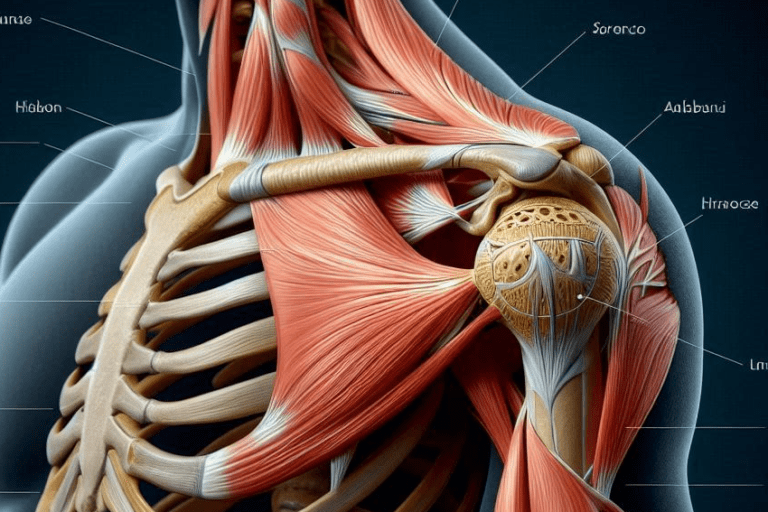
What is a Rotator Cuff Tear?
The rotator cuff is a group of four muscles Supraspinatus, Infraspinatus, Teres Minor, and Subscapularis — that stabilize the shoulder joint and allow smooth lifting and rotation of the arm.
A rotator cuff tear occurs when one or more of these tendons are partially or completely detached from the humeral head.
Patients usually present with pain while lifting the arm, difficulty in combing hair, or weakness in overhead activities.
This is one of the most common causes of shoulder pain — especially in people above 40 or athletes involved in repetitive throwing, swimming, or racquet sports.
⚙️ How Does it Develop?
Rotator cuff tears can develop due to:
- Degenerative changes: Over time, wear and tear cause thinning and fraying of tendons, especially in the dominant arm.
- Acute injuries: A sudden fall, jerky lift, or accident may cause the tendon to snap from its attachment.
- Repetitive strain: Continuous overhead activity, as seen in painters, athletes, or gym-goers, increases microtrauma to the tendon.
The result is inflammation, poor healing response, and eventual detachment — leading to pain and loss of strength.
⚠️ Risk Factors
- Age above 40 years
- Overhead or throwing sports (badminton, cricket, volleyball)
- Repetitive lifting or heavy manual work
- Poor posture or shoulder biomechanics
- Smoking, diabetes, and reduced blood supply to tendons
- Previous shoulder dislocation or trauma
🔬 Etiology & Pathology
Tears are typically located at the supraspinatus footprint on the humeral head.
Degenerative tears begin as partial-thickness fraying and progress to full-thickness defects.
With chronic tears, the tendon retracts, muscle fibers undergo fatty degeneration, and the biomechanics of the shoulder get disturbed — resulting in superior migration of the humeral head and eventual rotator cuff arthropathy if left untreated.
🧪 Investigations
- Clinical Examination:
- Painful arc test, drop arm test, and weakness in abduction/rotation.
- Imaging:
- X-rays — to rule out arthritis or bone spurs.
- Ultrasound — dynamic assessment of tendon integrity.
- MRI Shoulder — gold standard to determine tear size, retraction, and muscle quality.
💊 Management
🩹 Non-Surgical (For Small or Partial Tears)
- Rest and activity modification
- Physiotherapy to strengthen shoulder stabilizers
- Anti-inflammatory medication
- Ultrasound-guided PRP or corticosteroid injection (for pain and healing promotion)
🩺 Surgical (For Complete or Large Tears)
- Arthroscopic Rotator Cuff Repair:
A keyhole surgery where the torn tendon is reattached to bone using suture anchors. - Rehabilitation:
Guided physiotherapy begins immediately post-op to restore strength, stability, and range of motion. - Advanced Options:
For massive irreparable tears, procedures like Superior Capsular Reconstruction or Reverse Shoulder Arthroplastymay be advised.
🌟 Prognosis
With timely diagnosis, precise arthroscopic repair, and structured rehabilitation, most patients regain full range of motion and pain-free strength within 3–6 months.
Early intervention ensures excellent outcomes and prevents irreversible muscle degeneration.
💬 Key Takeaway
“Rotator cuff tears don’t heal by rest alone — but with modern arthroscopic techniques, recovery is faster, safer, and more durable.”